
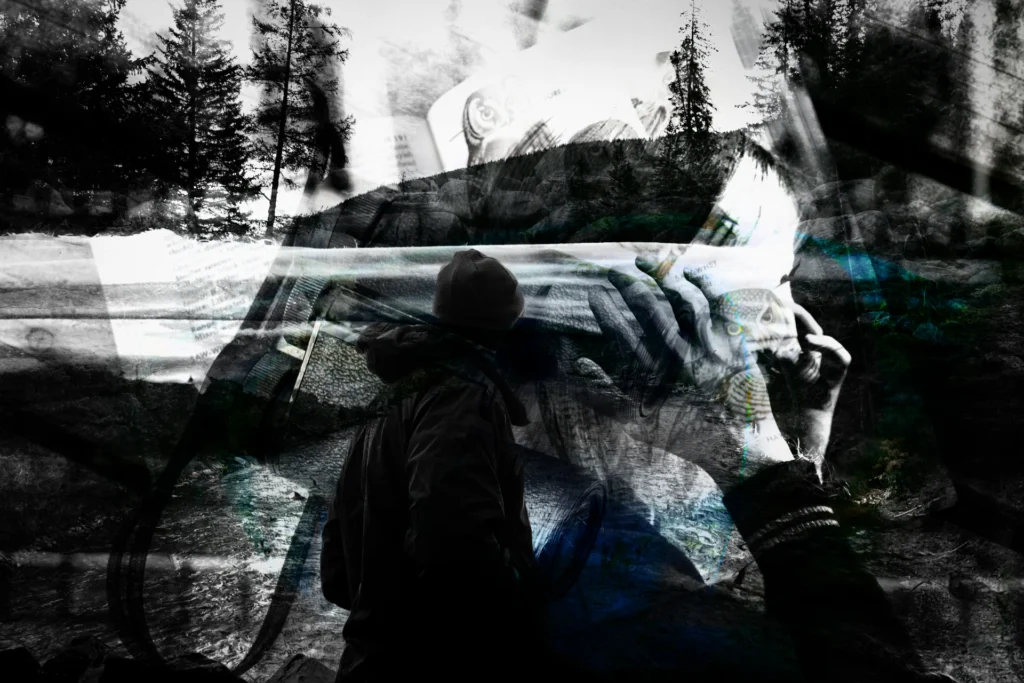
By the third week of October, the mergansers should have come through in clean, predictable numbers, sharp-backed, precise, skimming the river like punctuation marks. Mary had recorded them for fifteen years, long enough that the column of figures in her notebook felt less like data and more like a calendar she recognized. She knew when to expect them the way others knew when frost would come.
This year, they didn’t arrive.
She noticed it first as a hesitation. A gap in the page. She stood on the gravel bar with her binoculars raised, counting lesser scaups, a raft of mallards, one lone grebe, and then stopping, waiting for the mergansers to stitch the scene together. They never did. She wrote 0 in the margin and circled it, more irritated than alarmed. Last year, thirty-eight arrived one day, forty-two the next. Weather, she told herself. It was only a delay.
Two days later, another zero.
Mary worked alone for the state, contracted seasonally to band and log waterfowl along a narrow stretch of river that widened and tightened like a breath. She was careful with the birds, using steady hands and a quiet voice, but ruthless with her notes. Accuracy mattered. Precision mattered. The point was not what she felt but what she saw.
Except now, what she saw was absence.
She checked the weather maps. The jet stream had kinked south, then corrected. She emailed a colleague upriver, then one down. Same response from both: Odd numbers. Not catastrophic. Probably redistributed.
Redistributed was the word everyone used when no one wanted to say lost.
At home, Mary lined her notebooks on the kitchen table, fifteen years of slim, black spines. She ran her fingers down the columns for late October, tracing the rise and fall of numbers like a pulse. The mergansers had always come through here. Always. The river bend was a dependable pause in their long descent, a place to feed and rest before moving on
Unless something had changed.
The next morning, she drove farther north than usual, stopping at an unofficial pullout where the river narrowed and deepened. She scanned until her eyes ached. Nothing. She drove south, then farther, following the river’s logic instead of her assignment. Still nothing. The gap was not local. It was regional.
She marked a rough oval on her map with a red pen, a shape that felt too deliberate to be coincidence. A blind spot. Birds were passing around it, she suspected, like water around a stone.
That night, she dreamed of numbers falling out of her hands, scattering across the floor, slipping under doors.
Her ex-husband, Daniel, texted her after weeks of silence: Did you take the blue thermos? She started at the message, then at the thermos on her counter, its dented side catching the light. She typed Yes and nothing else. When he replied Okay, she felt the small, sharp relief of a question answered.
They had divided their life with a methodical calm that surprised everyone. Books alternated by color. The cast-iron pan went to him: the knives to her. What couldn’t be divided―friends, the long history of small habits―they agreed to leave untouched, like artifacts too fragile to move. Mary had told herself this was maturity, restraint, precision.
Now, she wondered if it was just another kind of blind spot.
In the field, she adjusted her routine. She started logging, not just what she saw but what she didn’t: empty reaches of water, stretches of sky without movement, the way the river seemed louder without the birds cutting through it. She knew better than to anthropomorphize, but the absence had a texture to it, a weight.
She called the regional coordinator, who listened patiently and said, “We need more data before we worry.”
“I have data,” Mary said. “I have fifteen years of if.”
“Then you know variability is normal.”
“But not like this.”
There was a pause. “Write it up,” he said finally. “Flag it. We’ll see.”
She wrote it up, carefully, neutrally, the way she’d been trained. She avoided words like vanishing. She used anomalous. Deviation. Unexplained redistribution. When she hit send, she felt hollowed out, as if she’d handed over something vital and been given nothing back.
The river changed color as the season deepened, taking on a darker, metallic sheen. Leaves gathered in slow spirals along the banks. Mary found herself talking aloud as she worked, not to the birds but to the space they should have occupied. She narrated the day, the weather, the counts. She kept her voice level.
One afternoon, she spotted a single merganser far out, its black-and-white body a small, defiant fact against the water. She lifted her binoculars, heart racing, and followed it until it vanished behind a stand of reeds. She waited with held breath. It did not reappear.
She wrote 1? in her notebook and underlined it twice.
That night, she pulled out an old atlas and spread it on the floor, weighting the corners with stones she’d collected over the years. She traced the migratory routes with her finger, following the familiar arcs south. Then she looked for the places in between, the unnamed wetlands, the unprotected stretches, the zones no one watched closely because no one lived there anymore.
She thought of the marsh near Daniel’s parents’ old house, the one that had been drained and replanted with soy. The birds used to stop there, she remembered. She had counted them once, years ago, while Daniel waited in the car, impatient to get back on the road. She had promised it would only take a minute.
It had taken twenty.
She drove there the next day. The marsh was gone, replaced by a flat, disciplined field. The drainage ditch ran straight and efficient, the water moving too fast to hold anything. She stood at the edge, listening. The sound beneath it―water, maybe, or something else―was constant, unbroken.
No birds.
Mary knelt and touched the soil. It was warm, even this late in the year. She imagined the mergansers approaching, circling, finding nowhere to land. She imagined them adjusting, rerouting, surviving in ways her maps did not account for.
She did not imagine them dying. She refused that option.
Back home, she opened a new notebook and began to sketch the blind spot in more detail, layering information: land use changes, temperature anomalies, unmonitored zones. The shape sharpened. It was not empty so much as invisible.
Daniel called while she was working. His voice sounded older to her, or maybe she was listening differently.
“I drove past the river today,” he said. “Didn’t see any birds.”
“No,” she replied, “you wouldn’t.”
With that, they sat in silence for a moment.
“I’m sorry,” he finally said, and she didn’t know if he meant for the birds or for everything else.
“So am I,” she said, truthfully.
Winter came early, locking the river in ice along the edges. Mary’s contract ended, as it always did, but this year she felt unfinished. She sent her notes to anyone who would read them. Some replied with polite interest. Others didn’t respond at all.
On the last day, she went out and stood longer than usual on the gravel bar, the cold biting through her gloves. A line of birds passed high overhead, too far to identify, their shapes reduced to motion. She followed them until her neck ached.
She did not write them down.
Instead, she closed her notebook and held it against her chest, feeling its familiar weight. She thought of the spaces between entries, the quiet years that had seemed so stable she’d barely noticed them passing. She thought of the blind spots in her own life, the things she had assumed would always be there, moving along predictable routes.
When she finally turned away, the river kept going, carrying with it what it could and leaving the rest behind.
Leave a Reply
Log in or Join the Crew to leave a comment.