
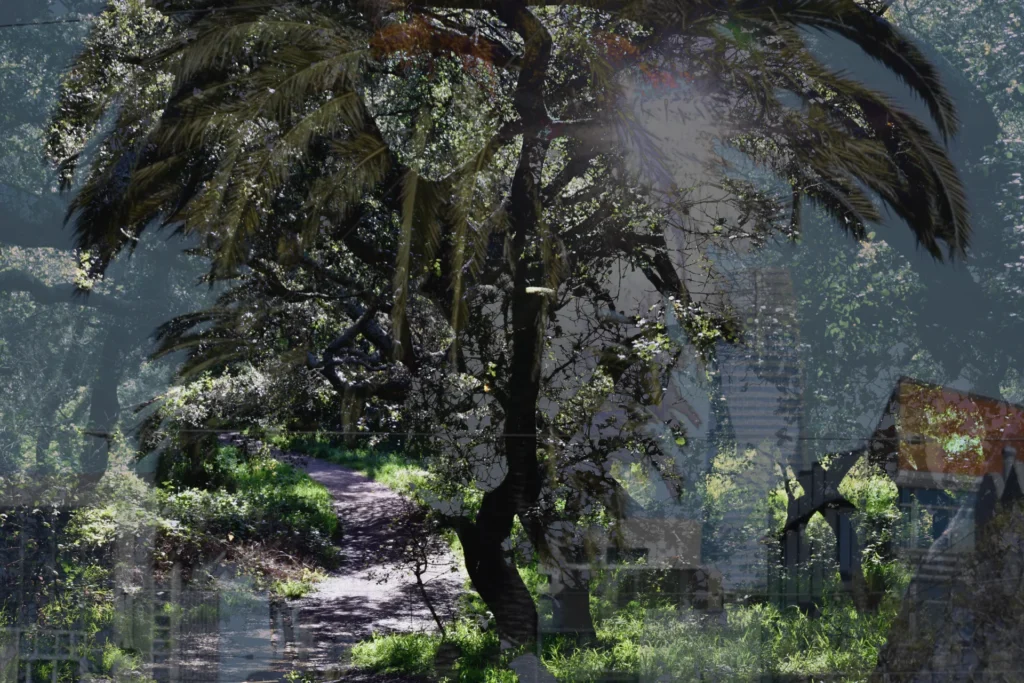
The first time Maily saw the Ravenala tree, it stood in the way of the morning light like a cathedral window. Its massive fan-shaped leaves trembled against the backdrop of red earth and distant mountains, a true reflection of Madagascar’s majestic landscape. She had come to study the island’s vanishing forests, but something about this particular tree—standing alone in a clearing near the village of Andasibe—seemed to hold a story deeper than any scientific research could capture.
Marcel, the local guide who had accompanied her from Antananarivo, spoke softly. “The travelers’ palm,” he said, rubbing his rough hand along the tree’s trunk. “We call it Ravenala. It gives water, shelter, and building materials—everything we need.”
Maily nodded, her fingers taking note of the intricate patterns of bark and leaf. She was a botanist, but more than that, she was a storyteller—someone who understood that every plant carries within it generations of memory and roots.
The research grant had been almost too easy to obtain. Climate change was reshaping ecosystems, and Madagascar, with its extraordinary biodiversity, had become ground zero for understanding ecological changes. Maily knew her work was more than data points and conservation strategies. It was about understanding the delicate network of relationships between humans and the natural world.
Her grandmother had taught her this, years ago in their small garden in Normandy. “Listen,” she would say, kneeling beside a patch of lavender, “every living thing has a voice. You just have to learn how to hear it.”
The village of Antsohihy sat like a constellation of old wooden structures against the green backdrop of the rainforest. Each house told a story about human evolution—tin roofs patched with salvaged materials, walls constructed from local woods that had survived countless seasons of rain and heat.
Razaka, the village elder, invited Maily to sit on a woven mat outside his home. The air was saturated with the scent of clove and distant woodsmoke. “The forest is changing,” he said, his eyes distant. “When I was a boy, the trees spoke to us. Now, they are becoming silent.”
Climate change was not an abstract concept here. It was a lived reality that altered everything; rainfall patterns, crop yields, and the very rhythm of daily life. The Ravenala trees that had once been reliable water sources here were becoming more sporadic, their roots struggling in soils that were either too dry or suddenly too wet.
Maily listened; her notebook open but mostly forgotten. Scientific observation was important, but true understanding required something more like a willingness to listen beyond the technical language of research work.
“Tell me about the trees,” she said.
Razaka smiled, a gesture that seemed to contain entire narratives. “Each tree is mindful. The Ravenala remembers when this land was different. When our ancestors walked these paths. When the lemurs were more numerous than the stars.”
The research took months. Maily mapped the changing forest ecosystems, documented the shifting ranges of endemic species, and tried to understand the complex interactions between climate, vegetation, and human communities.
Her first mapping expedition took her deep into the rainforest of Andasibe-Mantadia National Park. The landscape was like a living, breathing entity—massive trees draped in moss, orchids clinging to branches, the constant background chorus of unseen birds and insects.
Marcel guided her, his steps were fluid and precise. He knew every path, every subtle change in terrain. “The forest is not just plants,” he explained. “It is a community. The trees communicate. The fungi beneath the ground create networks more complex than any human communication system.”
Maily had read the scientific papers, of course. The work of researchers like Suzanne Simard, who had revealed the intricate communication networks of forests. But hearing it from Marcel, surrounded by the actual living ecosystem, was different. This was not an academic theory. This was reality playing out.
The lemurs watched them from the canopy—curious and vigilant. Ring-tailed lemurs with their distinctive black and white striped tails moved with a grace that seemed both bold and ethereal. Several species had become critically endangered, their habitats disappearing faster than any conservation efforts could respond to.
“We are losing them,” Marcel said, following her gaze. “Not just the animals. Their stories. Their influence.”
He told her about his grandfather, who had been a traditional healer. How he would walk these forests, studying the medicinal properties of plants that modern pharmaceutical companies were only beginning to comprehend. How each plant was a gift from the creator.
The research continued, but it was becoming clear to Maily that her work was taking a unique route. She was attempting to decipher—to create a bridge between different ways of knowing.
At the small research station she had set up in Andasibe, surrounded by maps and data collection equipment, Maily would sometimes sit and simply listen. To the sounds of the forest. To the stories told by Razaka and Marcel and the other villagers who had welcomed her.
Towards the end of her research, a cyclone swept through the region. Marcel helped the villagers prepare. Securing buildings, moving essential supplies, and creating emergency shelters. Not unusual for Madagascar, but increasingly intense due to changing climate patterns. Maily watched as the landscape transformed—trees bending, rivers swelling, the very ground seeming to shift and snap.
When the storm passed, they walked through the ravaged landscape. Some trees had fallen. Others had bent but not broken. The Ravenala trees stood particularly strong—their unique fan-shaped leaves allowed wind to pass through, and their deep roots anchored them to the shifting earth.
“They adapt,” Marcel said. “Like we must adapt.”
As she prepared to leave Madagascar, Maily looked back at the dwelling that had become more than a research site. It had become a home. A conversation. A living, breathing entity that had transformed her understanding of the world.
The journey back to Antananarivo was a slow unraveling of memories. Maily sat in the old Land Rover, watching the landscape drift—rainforest giving way to grasslands, then to the red earth that gave Madagascar its nickname of the “Red Island.”
Marcel drove, his hands steady on the wheel, occasionally pointing out landmarks or sharing brief stories about the places they passed. Each story was like a channel, connecting the present to a deeper, more intricate history.
At a small roadside market, they stopped. Women in bright Lambas—traditional wraparound cloths—sold fruits and vegetables. Their mangos stood out like the sunset, and their lychees glowed deep red. They also sold vanilla pods that carried the essence of the island’s most famous export.
An old woman approached Maily, her face exuding wisdom and grace. She held out a small bundle wrapped in a green leaf—something between a gift and an offering.
“For memory’s sake,” the woman said in Malagasy. Marcel translated, though the meaning seemed to exceed his translation.
Inside the leaf was a collection of seeds. Not just any seeds, but seeds from various native plants—some rare, some common. A genetic archive.
The research institute in Antananarivo has a blend of colonial architecture and modern scientific equipment. Maily spent days transferring her field notes, her collected samples, her intricate maps of forest transformations.
But the seeds from the old woman remained separate. They sat in a small wooden box on her desk. Dr. Rajoe, the institute’s director, reviewed her preliminary findings. “Your work is significant,” he said. “But its importance is not enough. We must translate your scientific findings into immediate action.”
Climate change was not a future threat in Madagascar. It was a present reality. Shifting rainfall patterns meant some regions were becoming desert-like, while others experienced unprecedented flooding. Endemic species—found nowhere else on Earth—were being pushed towards extinction.
Her research went on to be published in scientific journals. Her graphs and data told one version of the story—the measurable, quantifiable changes in forest ecosystems.
But Maily knew the real story was more complex. It was about the coherence of life. About listening to our planet. About understanding that every living system is a dialogue—sometimes inaudible, but always ongoing.
Leave a Reply
Log in or Join the Crew to leave a comment.