
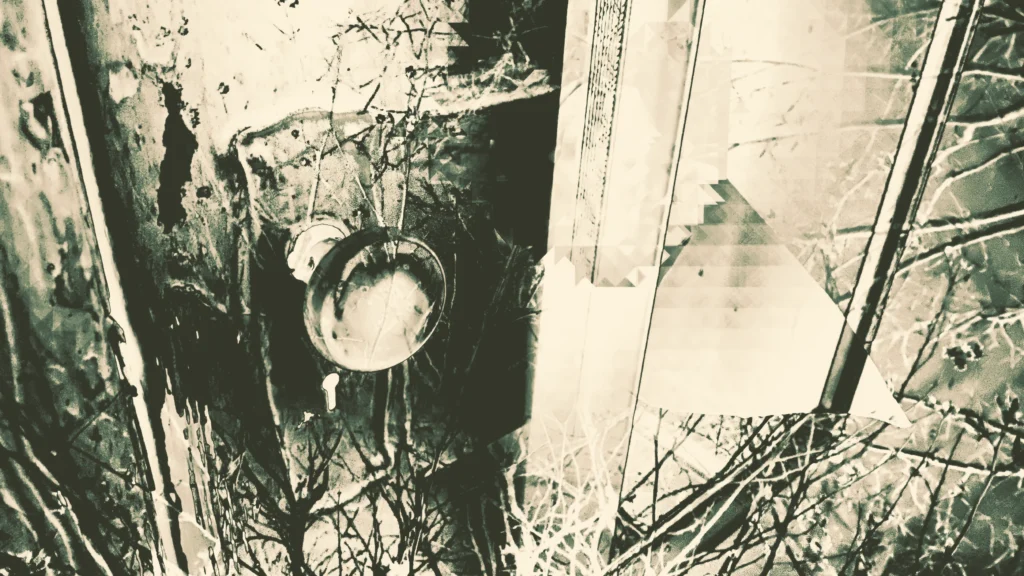
Ola decided to fly the same year her father quit his job to become a ventriloquist. Since she was born, ten years ago, Ola’s family had lived in an enormous Victorian house with floors that creaked and groaned like an old woman moaning over her aching joints. The interior was a patchwork of abandoned renovations, smelling of old sawdust and freshly dried paint, the doorknobs all mismatched: rusting metal globes, weightless stainless steel with a fold of lock in the middle, glass knobs like giant diamonds with sharp corners and a gaping keyhole clogged with paint. Ola had always imagined that if she found the right way to turn them, the doors would open into the past.
But when her father quit his job, they moved to the edge of town into a tiny mobile home balancing on a foundation of cement blocks. A pyramid of more blocks led up to the rickety screen and peeling door. Ola discovered she could squeeze through a gap into the bare dirt belly of the house and lay listening to the creak of feet moving above her, face to face with the gray tomcat who lived there. He had a torn ear and dirt in the corners of his nostrils. He didn’t like to be touched, but sometimes he rolled onto his back to look at her upside down with his bright golden eyes. He’d only bitten her once; Ola thought that meant they were friends.
The house sat on a square lot of dust and dead yellow grass. Every few weeks the landlady came to mow the dust, wearing sunglasses like bug eyes and a floral scarf tied over her untidy hair. The mower spat brown clouds that covered everything with a layer of grime. Usually, the landlady went away again with a wrinkled, yellowed check in her hand; sometimes she went away with nothing, grumbling.
Ventriloquy didn’t pay the bills.
Ola hoped that one day the landlady might take her as payment instead, plop her onto the worn Navajo blanket that covered the front seat of her sedan and give her a half-melted lozenge to suck as they bounced away down the rutted road, kicking up more clouds of dust.
Ola’s father used to work the information desk at the local Amtrak station: selling tickets, giving directions to the nearest burger joint, handing out paper schedules or finding lost luggage. He was good at his job. When the information desk was replaced with a shiny new kiosk, he was offered the position of station manager. He quit instead.
“It’s boring, that’s all,” he’d said to Ola’s mother when he broke the news. She was pale and clutching a washcloth like she might wring it in two. “This was as good an excuse as any to do something different.”
The insides of the Victorian house didn’t fit into the new, smaller house. Boxes were stacked floor to ceiling, making new walls, a maze that Ola had to find her way through. Once, she’d come around a corner to find her mother sitting on a stool and crying, her face an unhappy red. Ola crept away and tried to forget that.
There was a room with bunk beds for her, a bathroom with a pink plastic toilet, a kitchenette with a stove that ticked like a bomb when her mother lit it. At the back of the house, past the boxes marked “kitchen” that wouldn’t fit into the kitchenette, was her father’s ventriloquist studio. A sheet adorned with curling vines of pink flowers hung from the ceiling to make a wall. From behind it wafted the sharp smell of paint or wood glue and her father’s voice saying things like, “Good day to you,” or “How about that?” in a hollow monotone through lips that didn’t move.
He leaned the mirror that used to hang in the hallway against one wall and practiced with his reflection. But soon he was bored of practicing and sat them down to be his mirror instead, to clap like a row of windup monkeys when he’d finished his routine. Ola wasn’t allowed to ask questions because he might not know how to say the answers. So, she listened while he recited the alphabet and sang a song about frogs, then clap-clap-clap.
His mouth moved, she noticed. She sat as if hypnotized, staring at the blank look his face took on when he threw his voice, as if he were startled, at the tiny spasms in his lips and the red stain of beef stew in the corner of his mouth.
The idea to fly had come to Ola when she was watching her mother hang laundry. Shirts and linens and panties, all in a row on the line strung between two rusting T-posts, writhed and snapped in the breeze until finally a faded pea-green bath towel wriggled free of its pegs and flapped upward like an ungainly bird straining for the sky. A moment later, it crumpled and fell into the grass, a towel again. Ola picked it up and hung it back on the line, but not before she held it out and coaxed it to fly, to sweep her along with it. The towel fluttered halfheartedly and went still.
Thinking she needed something larger, Ola tried again with an old sheet. It had cowboys and bucking horses printed on it and a large tear in one corner. The sheet caught the wind, blossomed open like a sail, then it yanked out of her hands and twisted through the air until it snagged on the bare branches of the cottonwood tree in the corner of the yard. There it hung, too high to reach, and slowly shredded apart in the sun and rain. That spring, the bird nests were woven with white and brown and gray threads.
Her father used dummies when he practiced. His first dummy was a wad of socks who had lost their matches, stuffed into a pillowcase and cinched into a ball with string. It looked like a small lumpy ghost or a cabbage in a bag. Her father drew eyes and an open mouth on it with a paint marker, but he soon grew bored of a dummy whose mouth didn’t move. He left it stuck on the end of the broom handle, a severed head on a pole.
His second dummy was an old pressure cooker turned upside down so the hinged lid could open and close like a wide toothless mouth. He glued on mismatched buttons for eyes and handfuls of yellow yarn for eyebrows and hair. But this dummy was too heavy, he complained. It hurt his arm to hold it up. One day the hinge on the lid broke; after that, it lay forgotten in the dusty corner, its mouth hanging open like a broken jaw.
Sometimes he pulled Ola up onto his knee instead and told her to open and close her mouth when he touched her back just so. She flapped her lips and let her eyes glaze like a doll’s eyes, turning the world into smears of color and light. She woke much later to find that her body had hopped off his knee, brushed its teeth, and put itself to bed. Laying in the dark, she blinked her eyes over and over; they stung from being kept open.
Her father’s third dummy was beautiful. It had thick lashes and lids that blinked, painted red lips and downy black hair. It wore a lime suit jacket and a paisley skirt. The dummy improved his ventriloquy too. It told Ola things across the dinner table like, “Did you wash your hands?” or “Don’t pick that scab,” without her father even touching it.
After dark, it came into Ola’s room to tuck the blankets around her with its stiff wooden hands, pressing a kiss to her forehead with its hard rigid mouth. Too terrified to sleep, Ola lay on her stomach and watched the crack of yellow light around her door, so she’d know if the dummy came back. Most of the time it sat on a stool outside her father’s studio, staring ahead without blinking. Its painted skin looked so soft that Ola never dared touch it. She stayed outside and thought about flying.
Kites didn’t need much fabric to fly. They only needed wind and a running start. She tried sprinting around the yard, leaping like the gazelles she’d seen on a documentary about the Serengeti, the corners of a dingy red tablecloth clenched in her fists. When that didn’t work, she climbed up the creaking shutters onto the roof of the house, ran along its length, and threw herself into the air. Right before she crashed into the dirt, the tablecloth pulled taut, filling with a balloon of wind, yearning against her grip. Ola skinned her knees and bloodied her elbow; a nasty purple bruise formed on her chin. The house wasn’t tall enough, she reasoned. She would climb the cottonwood tree next.
But her body was beginning to change. Her arms and legs stiffened and cemented themselves in strange angles that made it difficult to walk. Her eyelids clicked when she blinked. When she poked her middle, instead of the soft hardness of her insides, her fingers sank into soft fluff.
“Smile, for goodness sake,” her father and his dummy told her, so her cheeks were always pulling her lips into a painful grimace. Soon her mouth didn’t move at all unless her father lifted her onto his knee and put words into it. She could move her eyes, back and forth, back and forth, like a swinging clock pendulum. All the dummies, lined up on their chairs, clapped their hands. How marvelous! How fun! What a pretty little doll!
Her hair was twisted into two stiff braids that stuck out over her shoulder joints, and she was dressed in a puffy pink skirt that hid her stiff legs and the ventriloquist’s hand that he used to move her mouth. When she managed to walk outside, swaying back and forth with her unbending knees, the gray tomcat pinned his ears and hissed at her.
Her thoughts were sleepy doll thoughts, sluggish and labored like a clock winding down. She sat and felt them drift past, not knowing what they meant, until one night when the wind growled and rocked the house on its crooked foundation. Somewhere in the dimness of the house, the ventriloquist murmured the Gettysburg Address and sang the alphabet out of tune.
A window had been left open. The sheer curtains floated and snapped. Then the doll who had once been Ola thrummed with wakefulness and remembered she wanted to fly. With her flat wooden hands, she pulled herself up onto the windowsill and tumbled through.
And because her dress was large and could catch the wind, because there was nothing left of her but fluff and yarn, her skirt billowed out, and away she flew.
Leave a Reply
Log in or Join the Crew to leave a comment.