
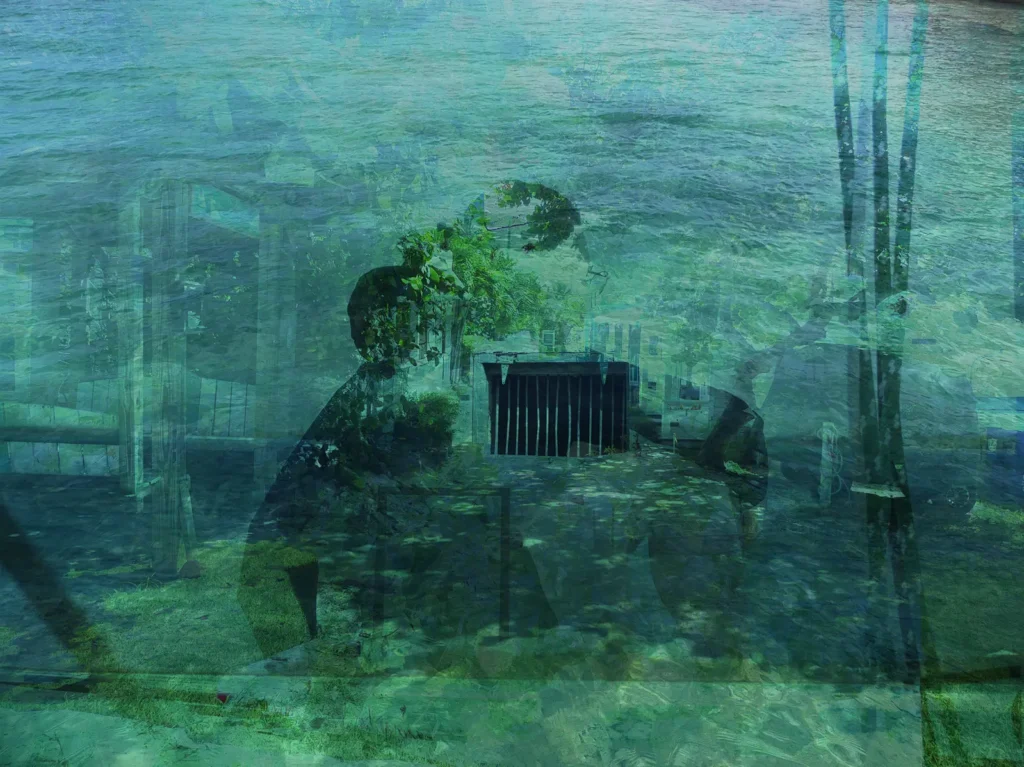
The dog’s body still floats in the garden, which has been invaded by nauseating greenery. This place should not have flooded. It never did before, but now my house is like a rock in a river. Every season, we drown a little more.
The rains do not stop.
Many days have already passed. There’s no electricity, no signals of any kind. Not even our radios can pick up anything. Our provisions will run out soon, just like they have for everyone else. With no way to heat our water or food; we’ll have to improvise with wood from the furniture we’ve been using to hold back the water trying to enter our home.
I don’t know how much longer we’ll be able to hold out. Help’s not coming. As days pass, we hear less and less news from our neighbors fighting this battle alongside us.
I remember watching a swirling current drag away Manuel, the shopkeeper. He disappeared.
The uncertainty is worse than the nightmares, but trying to communicate with our neighbors is dangerous because of the winds and lightning.
Mamá keeps her cool—more than usual. I don’t know if I should be worried.
My father seems absent, receding. Yesterday, he seemed too lost in thought, like he didn’t want to be here anymore. Usually, he’s either in a bad mood or too effusive, but it’s like he’s been torn away from the world.
Abuela sings to raise our spirits. She enjoys telling stories about hard times. Before, we were grateful that we weren’t in terrible situations like those, but now we ask ourselves which days are worse.
Day 18
We grow more and more tired.
There hasn’t been even a ray of sunlight in days—nothing but grey and white rain, cut by the gale.
There are more mosquitoes, and my fear of contracting some sort of infection increases. Fetid drainage waters mix with storm water, rising until they reached our living room.
Luckily, our house has three levels, unlike our neighbors across the street—a couple with a baby only a few months old. Their house only has one floor, the flood has already pushed them onto the roof. This is the first time in days that I’ve seen any of our neighbors.
I thought about helping them, but my father stopped me. No one else appears to help them, either. Still, I shouted to them, suggesting they put together a raft, offering my aid anyway. It seems like they’re mentally gone, however. I see that their baby is missing.
Abuela’s been very sad since that encounter with the neighbors. She never stops singing. She sings at all hours, never pausing. Even in the worst of times, she’s trying to lift our spirits.
Mamá is more distant, but she’s still here. She’s preparing to escape. That’s why she told us to build a raft.
My father worries me a lot. He seems like he’s somewhere else.
My sister believes we’ll get out of here, although perhaps it’s just childish naivety. Sometimes, she’s pessimistic, too.
I cover the windows and place obstacles on the stairs. The more I rescue what possessions and food I can, the more I ask myself whether we’ll survive.
Day 19
The neighbors are dead.
I think it was from the cold, or from hunger, but I can’t be sure from here.
Their bodies fall into the water, which hasn’t stopped rising.
My father says he hears voices at night. He gets sadder and more frustrated, and keeps repeating that “they” will rescue us soon.
He complains about the government and budget reductions, and he’s got us all sick of his theories about what kind of organization will come next after this catastrophe we’re living through. It’s the first time I’ve seen him give weight to such hypotheses, despite his distaste for them.
My mother doesn’t want to hear about them. She says they’re less useful each time he brings them up.
Abuela can’t help me, due to her growing weakness. She thinks death will come for her soon. She says this makes her happy, so it’s not a hindrance.
My sister assured Abuela that we’ll all make it out of this alive.
I’m not so sure.
I entertain myself by writing in this diary, and by drawing. Sometimes, I chat with my sister and my mother—they’re the most stable. I try to keep Abuela happy, but her mental and physical health worry me.
It’s getting colder.
I can’t get the image of my neighbors’ dead bodies floating in the current out of my head. I imagine their baby somewhere, under the water, devoured by fish or worms, wrapped in a blanket—or drowning in a crib.
There’s no trace of our other neighbors.
I don’t know if anything lives in these contaminated waters, but something probably does. I’m glad there aren’t reptiles in this zone, but I’m worried about scavengers, like catfish. Once, I read that if a catfish eats enough, it can grow up to three meters long.
I hope I never see one that big.
I ask myself when the rain will stop.
Day 20
Abuela still won’t stop singing. She almost never talks, like she’s absent from her own head. She’s weak and cold.
We only have crackers and some cans of beans left. We have to eat them raw, because there’s no way to warm them up. We’ve run out of alcohol and wood.
The flood stretches up the stairs, ever more menacing. The bookshelf won’t last much longer.
My father cut himself while working, and anxiety has consumed us.
We don’t have a way to dress his wound. This makes him worse—now, he’s not only sad, but he also knows he’s going to die.
His infection advances with overwhelming speed. I never thought something like this could be possible. He grows worse by the hour, says there’s a voice in the water calling to him.
Sometimes he laughs dryly, but I never find it funny.
My sister broke down crying earlier, and I consoled her for a long time.
Abuela didn’t react. I think she’s lost it. She tells us anecdotes and Biblical stories, her mind taking refuge in some unknown place while she talks about the Great Flood: “…And so, it rained for forty days and forty nights.”
I hear Mamá crying when she’s alone. I’m very worried about her. She tries to remain strong even when faced with the probable death of her husband and her mother’s dementia. Even when faced with the possibility that we all may die.
I saw our next-door neighbor’s body floating by our front door. Her house has two floors.
I try not to let panic swamp me. I won’t tell my mother about the body. I don’t want to scare her. I limit myself to telling Mamá that we could send out some bottles with messages in them to ask for help. The idea seems to have motivated her. She finds my sister, and together the three of us ask for help.
We know we’re going to die.
We all know we’re going to die at some point, anyway, but it’s never felt so palpable until now.
Which future will win? The one bringing help, or the one riddled with decay?
Day 21 (night)
Why won’t Abuela stop singing?
Day 22
Abuela is dead.
We found her curled up in a corner without a pulse, frozen. We put together a small burial mound for her, since there’s nothing else we can do for her body because the water keeps rising.
Fever and delirium have taken over my father.
Mamá can’t take this anymore. I see her scratching at her arms, and I’m worried that the mosquitoes got to her.
We’re all crying—except for my father, who doesn’t have the energy.
The second floor of our house is completely lost. Soon, the third floor will be lost, too.
I don’t understand how things have turned out so badly, even though we had space to protect ourselves.
I won’t surrender. We’ll fish if we have to. We’ll prepare to escape if necessary.
Our raft is ready to go. If the rain lets up, we can try it out.
Day 23 (night)
My father is dead.
He put his head under the water and didn’t take it out, not even by reflex.
He was already doing badly, with the fever and hallucinations consuming him.
I feel empty. Horrified.
Mamá is devastated. So is my sister.
We can’t continue much longer like this.
We’ll try to use the rafts to flee. There’s no other option.
I won’t let my sister or Mamá die here.
I refuse to let this deluge defeat me.
Day 24
One breath takes one second.
A day is made up of about twenty-two thousand breaths, but the last of them—alone among millions of others in the world—is the most important. Your entire life exists in that last instant.
When he drowned his last breath, my father left us. After using her last breath to sing, Abuela left, too. Their bodies have been swallowed by the water.
Mamá is doing very badly.
She hid her illness so we wouldn’t worry, but now we have to get out of here.
There’s no other choice. We have a raft ready, and my sister and I will go out on the water with it. I’m putting my diary here, like we did with the messages in the bottles, in case someone finds it. We can’t waste any more time.
If someone finds this, please:
Help!
The Spanish-language version of this story appeared in the Uruguayan magazine Revista Mordedor in 2021.
Leave a Reply
Log in or Join the Crew to leave a comment.